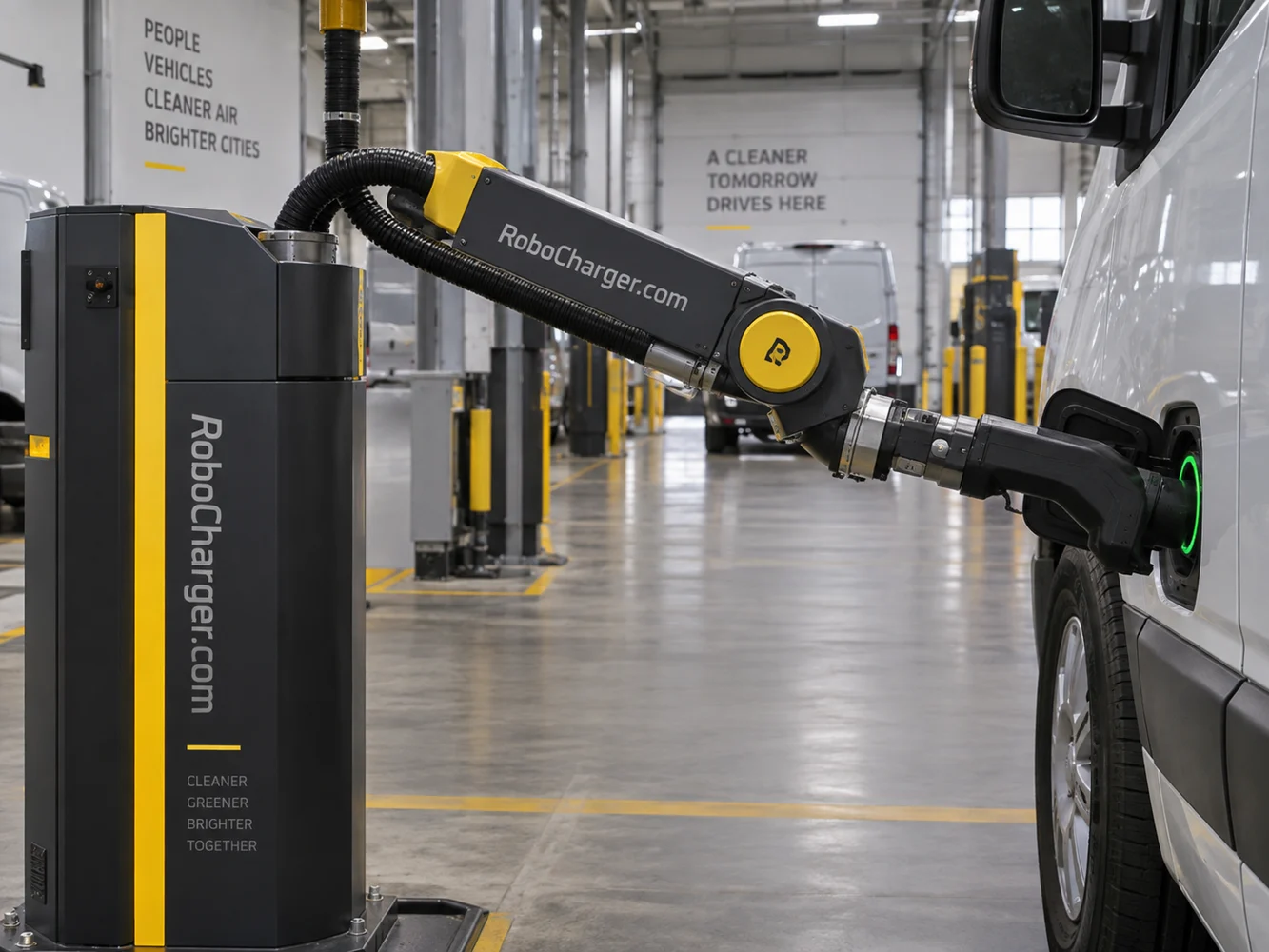
RoboCharger.com could be the public name for a business that makes connecting an electric vehicle to power part of an automated routine. The first customer need not be every driver on every street. A fleet with a predictable parking pattern offers a much clearer place to begin. The name puts the charging task in view while leaving the mechanism open to the product team.
This is an illustrative business concept. Picture a commercial fleet returning to the same depot each evening. The vehicles have assigned bays, their charging ports sit in known positions, and a supervisor needs them prepared for the next departure. A robotic connection system would have a specific job in that setting: handle the connection within an agreed operating envelope and report when human help is needed.
Choose the parking environment first
A depot and a curbside space may both contain parked cars, but they are different products to serve. At the depot, a buyer can potentially control the approach, bay markings, access, and schedule. A curbside installation has to contend with a wider set of users and parking positions. The choice affects the installation offer, maintenance arrangements, and customer support before it affects the shape of the enclosure.
A sensible first offer could concentrate on one depot configuration and one supported vehicle family. The commercial description would name those boundaries in ordinary language. It might describe an automated connection package for assigned indoor bays, with site assessment and commissioning included in the proposal. The fleet buyer could take that description to the site team and ask whether its conditions match the depot.
The Alternative Fuels Data Center’s fleet guide treats charging infrastructure and driver preparation as parts of fleet electrification. That wider context matters here: automating the connector is one decision within a larger fleet plan.
Package the first offer around responsibility
The first product sketch should show more than an arm beside a car. Include the charger, the connection equipment, the parking requirements, and the point at which the operator takes over. A buyer should be able to tell who surveys the location, who installs each element, and who answers the call when a vehicle cannot connect.
One possible offer has three parts: a site suitability review, a supported hardware package, and a service agreement. Keep those parts visible in the proposal. A facility that fails the initial suitability review should learn why before ordering equipment. A location that needs building work should see that dependency separately from the charging product itself. The proposal becomes easier to approve when the boundaries match the work people will actually perform.
Spare parts also belong in this early sketch. Identify which wear items a local technician can replace and which repairs require the manufacturer. Buyers can then compare service arrangements on something more useful than a general promise of support.
Keep the software description precise
An EV charging system can involve several distinct conversations between devices and management tools. The Open Charge Alliance describes OCPP as communication between charging stations and charging management systems. A product description should identify the actual supported connection and version rather than letting a protocol name stand for the entire installation.
For this concept, the public site could separate three capabilities: making the physical connection, managing a charging session, and sharing its status with a fleet tool. Each capability needs its own evidence and ownership. A fleet manager should not have to infer that a management integration also makes every vehicle physically compatible.
The first product page could include a simple responsibility diagram. The installer owns the site connection. The equipment supplier owns the supported docking behavior. The fleet operator owns dispatch priorities. The actual arrangement would depend on contracts, but spelling out the proposed division helps a customer ask better questions during evaluation.
Reach buyers through a narrow channel
A credible distribution path is a partnership with a depot equipment integrator serving a known fleet segment. That relationship could put the proposed charger in front of people already planning a facility change. It also creates an opportunity to learn what prevents an installation from moving forward: procurement timing, site work, maintenance coverage, or a mismatch with the vehicle schedule.
A demonstration should follow a buyer’s ordinary sequence. Show the vehicle entering the bay, the connection attempt, the charge state handoff, and the response to a blocked connection. A polished successful connection is useful, but a calm explanation of recovery is often the more informative part of the conversation. Record the conditions of the demonstration so later sales material describes what was actually shown.
Put the brand on the whole customer journey
RoboCharger can appear on the equipment, the installation guide, the service portal, and the compatibility page. RoboCharger.com then becomes the address printed on the housing and shared by the installer. The fit is strongest when the site helps a buyer move from interest to an informed specification discussion.
A first navigation might include applications, supported vehicles, installation, and support. Each section has a different job. Applications establish the use case. Supported vehicles define scope. Installation explains site preparation. Support tells an operator where to go after commissioning. That structure leaves room for a second product without rewriting the original offer.
Before acquiring the domain, write a one-page proposal naming the first fleet segment, installation setting, and product responsibility. Bring those details to an inquiry about RoboCharger.com. They provide a useful basis for discussing how the domain would support the business from its first controlled installation onward.