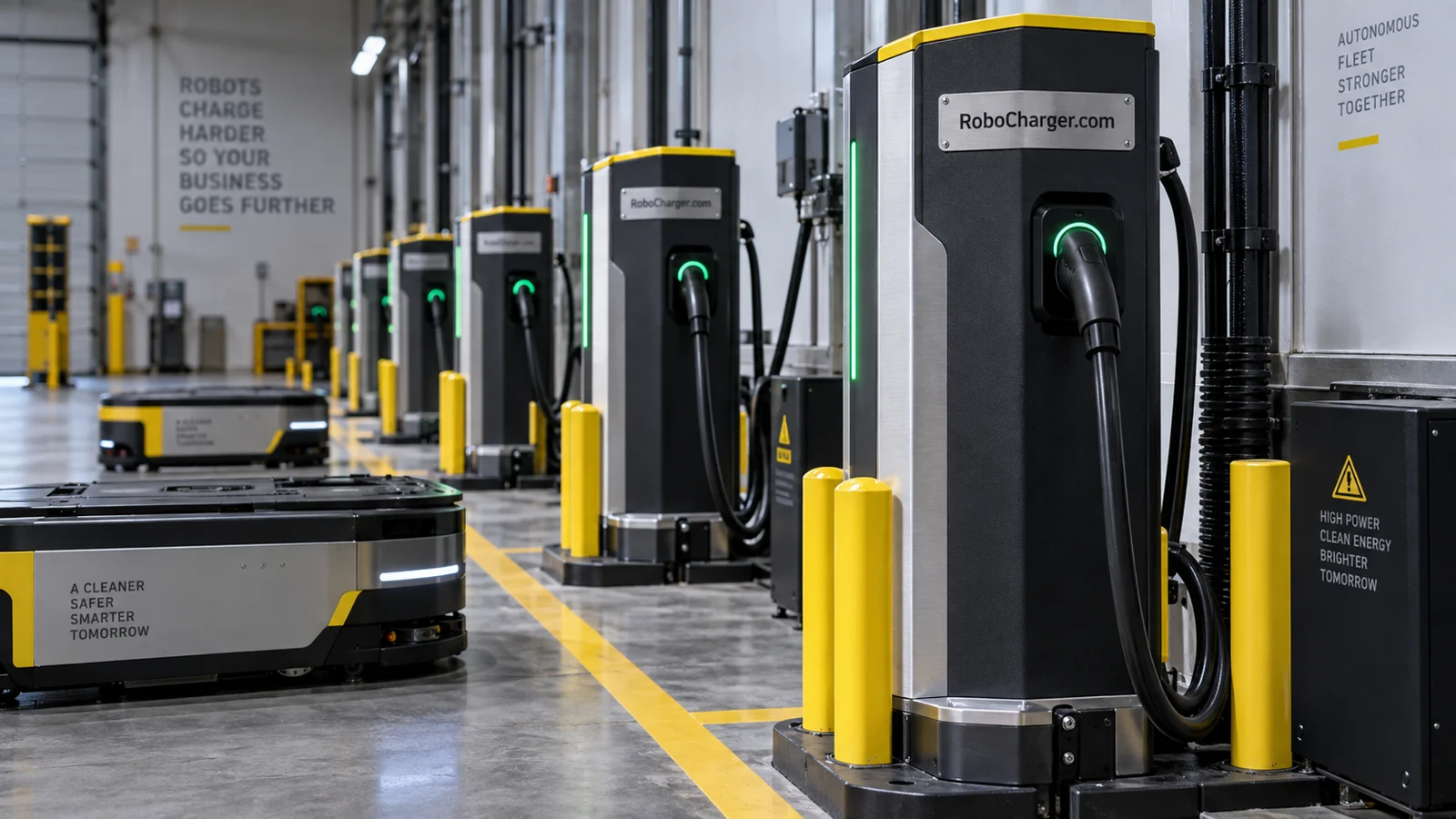
RoboCharger.com could name a software platform that helps a fleet decide what needs charging, where it can charge, and who should respond when the plan breaks down. The customer would buy coordination rather than a new enclosure. That distinction gives this concept a different product roadmap from a dock manufacturer, even if both businesses serve the same facility.
The first customer could be an operator with several charging locations and a mix of scheduled work. A dispatcher wants assets ready for their next assignment. A facilities manager needs visibility into unavailable bays. A maintenance team needs exceptions with enough detail to act. A useful platform would let those roles work from a shared record without asking them to use identical screens.
Start with three modules
This is an illustrative product concept. Its first module is an asset and bay register. It records which vehicles or robots exist, which charging locations are available, and what combinations are supported. The register needs an owner because a newly installed dock or replacement vehicle can make yesterday’s assumptions incomplete.
The second module is a charging plan tied to upcoming work. It shows the next required departure or task and the proposed charging window. The first version could make recommendations for a supervisor to approve, keeping the operating decision visible. Automatic control should be introduced only for the equipment and conditions the product actually supports.
The third module is an exception queue. A failed connection, unavailable charger, or missed return should arrive with a clear status and an assigned person. The queue should distinguish a problem that needs attention from one already being handled. That modest distinction can be more useful to a shift team than an elaborate visualization of every possible metric.
Keep control boundaries visible
The platform needs to say which systems it reads and which systems it can command. A status feed may provide a useful picture while offering no authority to change charging behavior. A command interface may be available for only part of a mixed fleet. Treating those cases alike would make the product harder to operate safely and honestly.
For EV charging, the Open Charge Alliance’s OCPP overview explains a station-to-management communication layer. A product team should document the particular implementations it supports. It should also explain how any robot fleet interface relates to that EV layer instead of suggesting that one protocol automatically covers all equipment.
A clear product page could use three labels: monitored, scheduled by recommendation, and directly controlled. Each installed integration would have one defined scope. The operator could then understand why the platform can reschedule one asset but asks for a human action on another.
Give each role a useful starting screen
A dispatcher’s screen might begin with the next departure list and any asset at risk of missing it. The facilities view could begin with unavailable bays and planned maintenance. The technician’s view could show the assigned incident, the last known state, and the approved recovery procedure supplied by the equipment owner.
Permissions should follow those responsibilities. The person reviewing a report may not need authority to change the plan. A supervisor covering another shift may need a temporary handover rather than a permanent new role. These are product decisions to resolve with actual operators during discovery.
For a hypothetical mixed depot, imagine an early-returning EV and a warehouse robot requesting access to different charging equipment. The system should preserve their distinct compatibility constraints while showing the supervisor how both affect the work schedule. A shared planning view can be useful without pretending the assets share a charger.
Sell an implementation with a defined boundary
The first offer could cover one location, a named set of integrations, and a documented operating workflow. The customer would see what information must be supplied, which systems need access, and how acceptance will be evaluated. Expansion to another location would follow a review of its equipment and operating pattern.
The Department of Energy’s smart charge management discussion describes coordinated EV charging in relation to fleet operations and energy constraints. It supports considering those inputs together, but a new product would still need its own evidence for any claimed outcome.
Commercial proposals should therefore separate the subscription, implementation work, and optional integration work. A buyer can then compare the recurring product with the effort needed to make the first site usable. Avoid hiding a large integration project inside a simple monthly software label.
Reach the first customers through operations
A credible route to market is a small set of depot or automation integrators that can introduce the software during a facility expansion. Another is a direct pilot with an operator willing to map its existing exceptions. Both routes need a narrow scope and someone accountable for the daily workflow.
The pilot should compare the agreed process before and after the software is introduced. Useful questions include whether exceptions have owners, whether departure priorities are visible, and whether staff can recover when a feed is stale. Commercial results should be reported only when the measurement supports them. A fictional dashboard number is no substitute for an observed change in work.
Export and handover matter as well. A customer should know how to retrieve its asset register, operating records, and incident history. The product becomes easier to evaluate when the business relationship has a practical exit path as well as an onboarding plan.
To discuss acquiring RoboCharger.com for this concept, bring the fleet size, vehicle or robot mix, and first integration target. Describe whether the initial product would advise operators or control supported equipment. Those choices establish the actual offer behind the platform name.