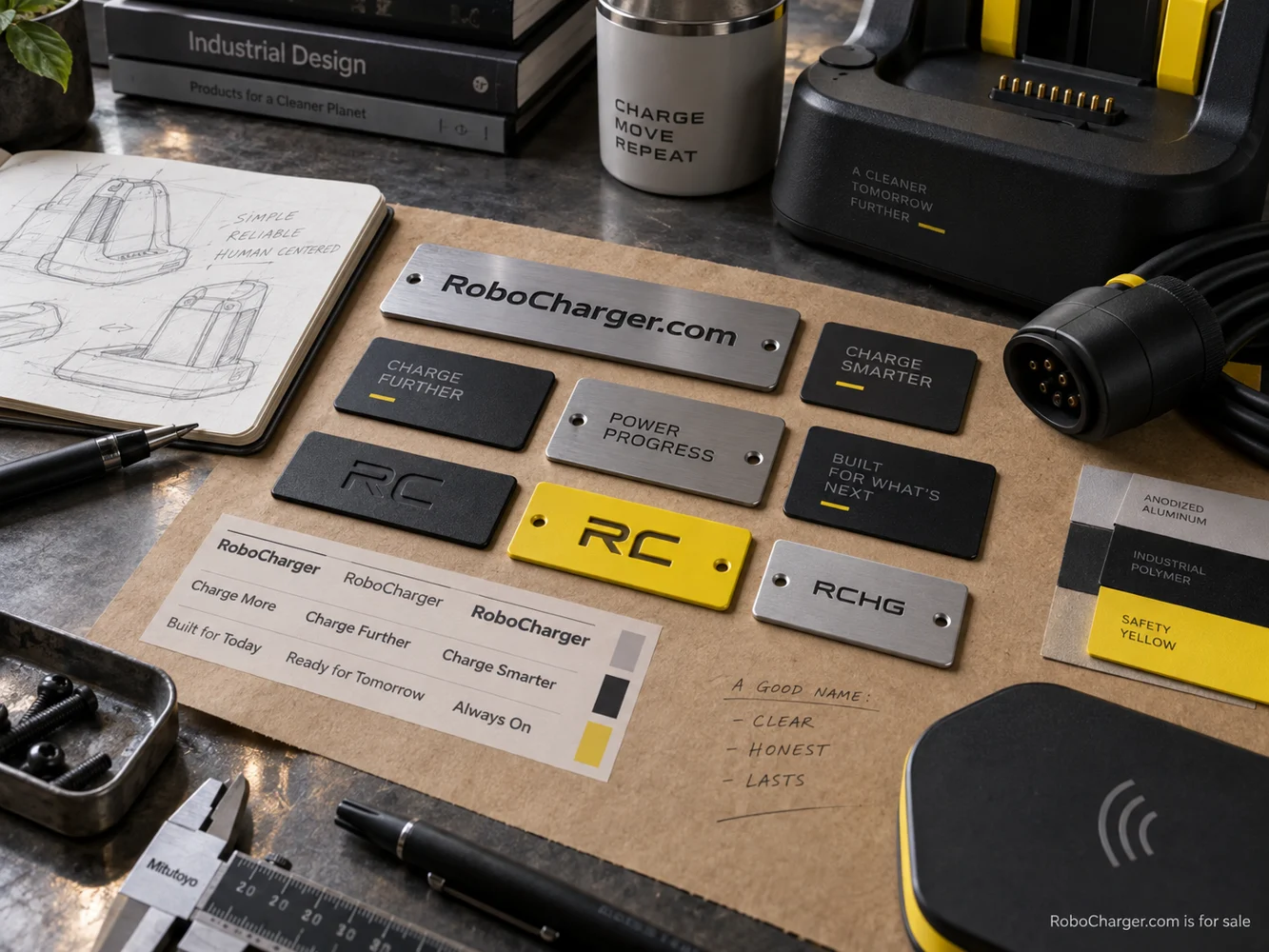
A charger name can start making promises before the product description appears. Words such as automatic, autonomous, universal, and smart invite a reader to imagine a capability. The team writing the name may have a narrow feature in mind, while a customer hears something much broader. That gap is worth finding before the name reaches a housing label, distributor catalog, or purchase order.
The practical task is to separate three layers: the brand, the product family, and the feature description. A brand gives the business an identity. A product family groups related offers. A feature description explains a supported action. When those layers are kept legible, the company can introduce new products without forcing one broad promise onto every unit.
The examples here are illustrative copy exercises. Product claims need evidence appropriate to the actual offer, and trademark questions require separate professional review. A domain acquisition does not settle either issue. The purpose of this guide is to make the naming discussion more specific before those reviews take place.
Give each naming layer one job
RoboCharger could serve as a house brand. A product family underneath it might distinguish an indoor robot dock from an EV connection system. A configuration identifier could then distinguish mounting arrangements or supported variants. The customer should be able to tell which part of the name describes the company and which part selects the item being purchased.
For example, a hypothetical RoboCharger Dock F1 tells a reader that the item belongs to a dock family, while leaving room for the product page to explain its supported use. Adding an unsupported label such as universal would change the expectation. The shorter configuration name may be less dramatic, but it gives the specification room to do its proper work.
Write the proposed name in four settings: the page title, the quotation, the box label, and a spoken support request. If it works only in the marketing headline, it is not yet doing the full job. Someone should be able to request the correct replacement part using the same family and configuration names.
Replace umbrella claims with observable actions
Take the phrase fully autonomous charging. Ask the product team which actions it includes. Does the equipment locate a vehicle, make a physical connection, request charging, schedule energy use, disconnect, and handle exceptions? Which of those steps require the vehicle, the operator, or another system to act?
A more useful description might say that a product connects to a supported vehicle after it is parked in an assigned bay. That sentence has a subject, an action, and a condition. It gives the customer something to compare with the proposed installation. The final wording must still match the product’s evidence, but the structure makes the review possible.
The FTC’s advertising guidance calls for truthful, evidence-based claims. Use that as a reason to collect the support for objective statements before publication. The naming exercise should lead to an evidence question whenever a word implies a measurable capability.
Read the whole page as a customer
A narrow sentence can be undermined by a broad image or heading. A page showing several unrelated robot types beside one dock may suggest compatibility across all of them. If the supported range is limited, the page should make the actual offer clear where the buying decision happens.
Ask someone outside the project to describe the product after a quick read. Do not begin by explaining what the team intended. Ask what equipment they think is supported, what the product does automatically, and what they expect to receive. Their answers can expose a mismatch between the internal definition and the public impression.
This is a comprehension exercise, not a substitute for formal review. Keep the participant’s words so the team can see where ambiguity entered. If several people infer the same unsupported capability, changing a footnote may be less useful than changing the headline or image.
Build a claim ledger alongside the names
A simple claim ledger can contain the exact wording, where it appears, the evidence supporting it, and the person responsible for review. Include product names and image captions, not only paragraphs. A distributor may copy a short title while omitting the longer explanation, so the short version deserves attention of its own.
| Draft wording | Question to resolve | More specific direction |
|---|---|---|
| Universal robot charger | Which exact models and configurations are supported? | Name the supported family and link its current list |
| Autonomous depot | Which tasks still require operators? | Describe the particular automated charging action |
| Smart charging | What decision does the product make or recommend? | State the scheduling or monitoring function |
| Maintenance-free dock | What inspection and replacement work remains? | Describe the documented service requirements |
The more specific directions are writing prompts, not ready-made claims. A team still needs to fill them with facts about its own product. The ledger helps preserve those facts when a page is edited, translated, or reused in a sales deck.
Keep communication terms in their lane
Technical abbreviations can create the same problem as marketing adjectives. A buyer may see a supported protocol and infer that every piece of equipment using the same term will work together. The product page should identify the supported function, version, and tested scope in language a purchasing team can follow.
For example, the Open Charge Alliance describes OCPP in relation to charging stations and management systems. That is a communication role. It should not be used as shorthand for physical connector compatibility or robotic positioning. A precise integration section can explain the role without loading every detail into the product name.
Give the technical description its own location near the specification. The name can remain manageable while the supporting information stays easy to find. This also makes updates easier: a supported software release can change without creating an unnecessary new house brand.
Plan the name for a second product
Imagine the company adds a manual accessory, a monitoring tool, or a different dock configuration. Would the existing family structure explain the relationship? A house brand that requires every product to perform the same automated action may become awkward as the range expands.
A useful architecture leaves the stable identity at the top and places changing capabilities lower down. The family name groups the offer. The configuration selects the item. The feature description explains what it does under specified conditions. This structure can be applied consistently across catalog filters, support pages, and packaging.
It also helps retirement and replacement. If a model is discontinued, the support page can identify it precisely and explain the replacement path. Reusing a name for materially different equipment can make that task harder, especially when older units remain in service.
Rewrite one claim before the next launch meeting
Choose the broadest capability statement in the current draft. Underline the action it promises, circle the equipment it appears to cover, and list the conditions that make the statement true. Then write a sentence that names those elements plainly. Ask engineering, support, and commercial reviewers to compare it with the actual offer.
The FTC’s substantiation policy is a useful reference for the evidence discussion. Keep professional review separate from the creative preference for a particular name. A strong name helps a customer recognize the product; an accurate description helps that customer decide whether it belongs in the intended application.